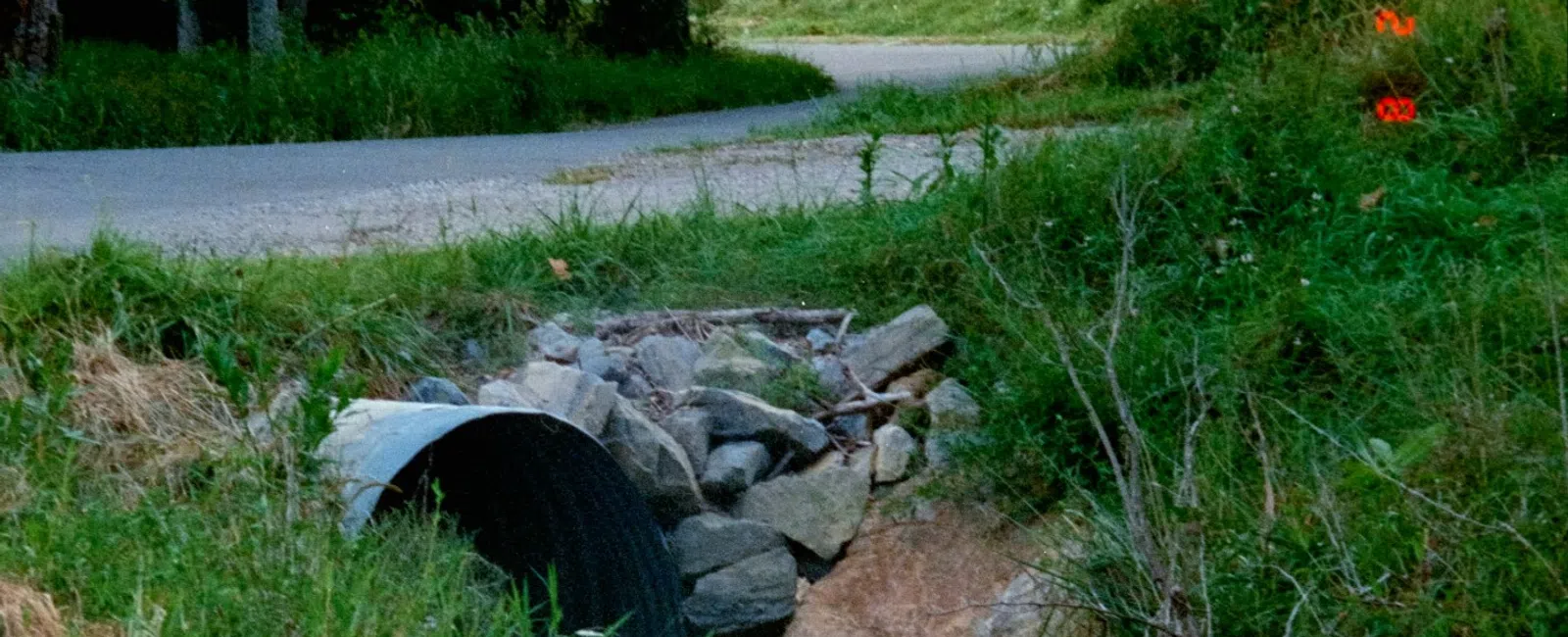
A driveway culvert may seem straightforward, but getting it wrong can cause serious problems. If the pipe is too small, poorly placed, or not supported correctly, heavy rain can wash out the entrance or weaken the driveway above it. A culvert that handles normal traffic may also fail under the weight of a delivery truck, tractor, or other heavy equipment.
Before installation begins, it is important to choose the right pipe, understand the drainage requirements, and check whether Virginia permits or approvals are needed. Here is what property owners should know before installing or replacing a driveway culvert.
You almost certainly need a permit
If your entrance connects to a state-maintained road, and nearly every farm road in Southwest Virginia does, installing a culvert means working inside VDOT right-of-way. That requires a land use permit before the work starts.
The one you want is the LUP-PE, the private entrance permit. It covers entrances serving up to two residences, and it specifically covers entrances that give agricultural operations access to their fields. VDOT's authority here comes from sections 33.2-240, 33.2-241, and 33.2-245 of the Code of Virginia. Working in the right of way without a permit is a misdemeanor under 33.2-210, and the property owner is civilly liable for whatever VDOT spends putting the road back.
The application fee is $100. On top of that, you post a refundable surety, sized by the district administrator's designee based on the estimated cost of the work in the right-of-way. Local permit packets commonly list $500 for a straightforward private entrance, which comes back to you after VDOT inspects the finished job. Some districts process a clean application in about five business days.
If you are pulling timber and only need access for the duration of the cut, ask the district about the temporary logging entrance permit instead. It is written for exactly that situation.
Choosing culvert pipe material
Three materials cover most farm entrances.
- Corrugated HDPE, the black plastic dual wall pipe, is the common choice now. It is light enough to set by hand in the smaller sizes; it does not rust, and it costs less than the alternatives. It needs adequate cover and careful backfill because the surrounding soil does part of the structural work.
- Corrugated galvanized steel handles rough treatment and heavy loads well. Its weak point is the invert, the bottom of the pipe, which sits wet and eventually rusts through. Steel culverts in acidic soil or in a ditch with year-round baseflow have a shorter life than the same pipe in a dry ditch.
- Reinforced concrete is the heaviest, the most expensive, and the longest lasting. Setting it takes equipment. For a high-traffic entrance carrying loaded trucks year after year, it earns the cost.
Whatever the permit specifies is what goes in the ground. Substituting a cheaper material after the inspection puts your surety at risk.
Cover depth is what keeps the pipe round
The single most common way a landowner destroys a new culvert is driving a tractor or a loaded trailer across it before there is enough material on top.
VDOT single-lot guidance calls for a minimum of nine inches of cover over the pipe. County design standards in Virginia often go further. Roanoke County, for example, requires at least twelve inches of backfill over HDPE or corrugated metal before construction traffic crosses. Neither number is a suggestion. Below that, the load from a single axle transfers straight to the pipe wall instead of spreading through the fill.
Build the crossing up to full depth with compacted aggregate, then drive on it. Not before.
Setting the pipe at the right elevation
Match the pipe invert to the existing ditch flowline. Set it too high and water pools behind the inlet, then cuts around the end of the pipe rather than through it. Set it too low, and the pipe silts in over a couple of seasons until it is a solid plug of mud.
The pipe also needs to be long enough. VDOT permit conditions call for culvert pipe to extend at least a foot beyond the toe of the stabilized slope on each end. Cutting a pipe short to save money means the fill above it slumps into the ditch and starts choking off the inlet within a year.
Bed the pipe on compacted stone rather than dropping it on raw trench bottom, and work backfill in around the haunches and the lower sides of the pipe in lifts. Void space along the bottom third is where deflection starts.
End sections or headwalls at both ends protect the fill, keep the mouth open, and make the entrance considerably easier to mow. Larger diameter culverts typically require concrete wingwalls under local design standards.
Before you dig
Notify Virginia 811 and let the locate happen. It is required by law, and rural entrances have more buried lines running through them than people expect.
If your work will be within 1,000 feet of a signalized intersection or near VDOT traffic infrastructure, permit conditions require contacting the VDOT Customer Service Center at 1-800-367-7623 at least 48 hours ahead of excavation.
Who maintains it once it is in
Under Virginia administrative code 24VAC30-73-90, maintenance of a private entrance falls to the owner of the entrance. There is one useful exception. On highways with ditches, VDOT will clean the drainage pipe at the entrance and may replace it if replacement is needed to preserve the highway and protect the traveling public.
That does not make it VDOT's pipe. Everything from the right-of-way line onto your property is yours to keep clear. Pull sediment out of both ends, keep brush cut back off the inlet, and fix erosion at the outlet before it works its way back under the fill.
Knowing when to replace instead of patch
A driveway culvert replacement is warranted when you see rust holes along the invert of a steel pipe, crushed or flattened ends, joints that have pulled apart and are letting water into the fill, or a pipe silted in past roughly a quarter of its diameter that will not flush clean.
Patching a pipe that is failing structurally is money spent twice. The second time includes rebuilding the entrance around it.
What drives the cost of the job
We are not going to quote you a number on a web page, because the honest answer depends on the site. What moves the price is pipe diameter and length, how deep the trench has to go, how much stone the crossing needs, whether the ditch line above and below has to be regraded to make the pipe work, and whether the entrance itself needs widening or brush cleared for sight distance. A culvert going into an established ditch on gentle ground and a culvert going into a washed out entrance on a grade are two different jobs.
Get the permit first, get the size right, and the pipe will outlast the truck you are driving now.
Ranch Hand Agricultural Services is a farm and land operation based in Abingdon, Virginia, owned and operated by Matthew Hubble and backed by HD Livestock. We handle entrances, farm roads and barn lots, land clearing, fencing, and ongoing farm maintenance across Washington, Smyth, Russell, and Wythe counties.
If you have an entrance that needs a culvert set, or one that is washing out every spring, request a quote or call 276-739-8116. Here is how our process works.